Council Considers Changes Affecting Commercial Fishermen, Headboats, and Spawning Areas

The South Atlantic Fishery Management Council held its quarterly meeting last week, March 2-6, 2026, in Jekyll Island, GA. Much of the week was spent in the Snapper Grouper Committee, addressing topics such as commercial management measures, fishery management unit revision, and headboat vessel limits. The Council also discussed the SEDAR committee, including a name change to the program, and the scheduling of the Mackerel Cobia Advisory Panel meeting in fall of 2026 and subsequent assembly of the committee in March 2027.
Commercial Management Measures (Amendment 60)
The Council began the week by convening the Snapper Grouper Commercial Sub-committee to discuss next steps for Amendment 60, addressing commercial management measures. This amendment intends to increase flexibility and adaptability in the commercial snapper grouper fishery by revising permit accessibility, trip limits, and bottom longline gear stowage requirements to allow fishermen to switch from, or to, bottom longline gear during trips.
The sub-committee discussed the potential removal of the “2-for-1” provision for unlimited commercial permits (SG1), noting public opposition and concerns related to leasing vessels and associated permits. The sub-committee will continue evaluating possible changes to the commercial permit structure, including limits on permit ownership, when they meet in April 2026. The amendment will also consider a range of trip limit changes for several snapper grouper species and develop a process that would allow temporary trip limit increases or decreases through an annual evaluation and temporary changes to the trip limits issued by the NMFS Southeast Regional Office.
Snapper Grouper Fishery Management Unit Revision (Amendment 61)
On Wednesday, the Council continued discussions on Snapper Grouper Amendment 61, addressing a reduction in the number of species included in the Snapper Grouper Fishery Management Unit (FMU). The Council addressed a subset of species identified for further evaluation in terms of the need for conservation and management to better align with the Magnuson-Stevens Act. Changes to species could include removal from the FMU or designation as an Ecosystem Component (EC) species. EC species remain in the Fishery Management Plan (FMP) to support ecosystem management goals, but do not face management measures such as annual catch limits.
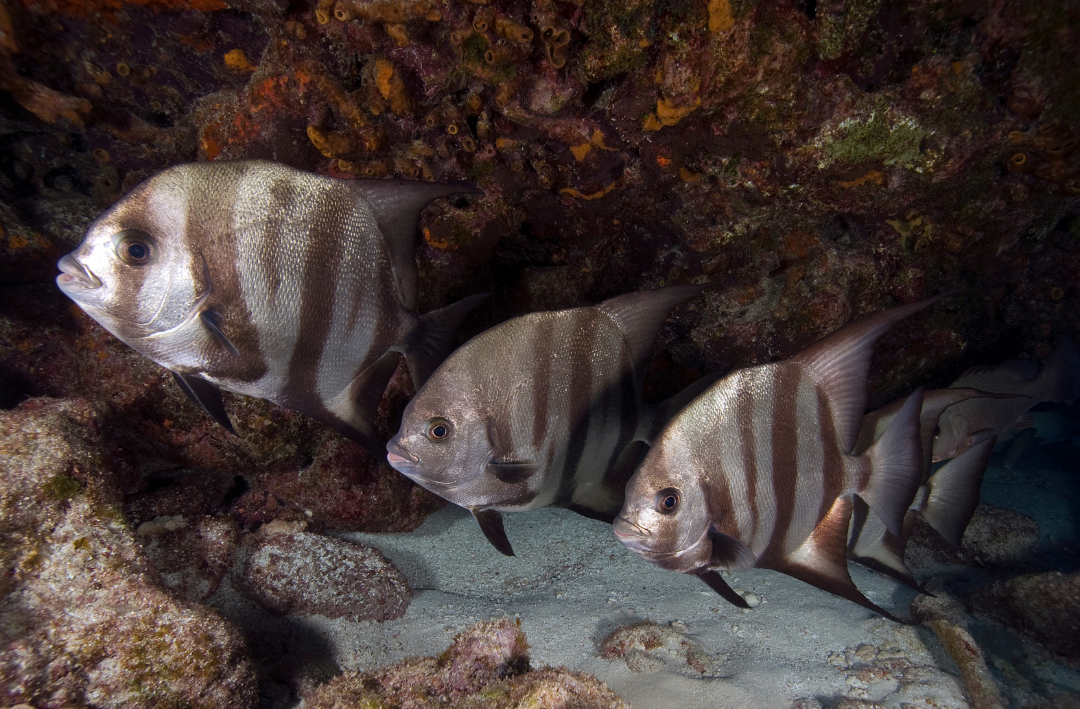
Council staff recapped background data showing the annual catch limits across the candidate species to help narrow down which species would continue to be considered in the amendment. Bar jack, Atlantic spadefish, and misty grouper were identified as species that could be evaluated further, whereas queen snapper, cubera snapper, and banded rudderfish will no longer be evaluated in Amendment 61 and will remain under their current level of federal management.
Headboat Vessel Limits
The Council discussed potential changes to improve how retention limits apply to federally permitted headboats. Council staff presented a preliminary analysis examining how “one fish per six passengers” could affect landings for gag and black grouper, scamp, yellowmouth grouper, and snowy grouper. For gag and black grouper (currently 2 fish of each species per person per day), shifting to one fish per six passengers would have little impact on overall catch levels. For scamp and yellowmouth (currently a maximum of 3 fish of either species), one fish per six passengers would increase harvest by around 5%. Snowy grouper were initially included in the analysis but were removed from further consideration after concerns were raised about the species’ overfished status and existing strict regulations (currently one per vessel).
The Council voted to begin developing a framework amendment to establish vessel limits for federally permitted headboats based on the number of passengers aboard. For example, if the limit were two fish per six passengers, a vessel carrying 13 passengers could retain four fish. The amendment would further analyze the potential impacts of this approach and include opportunities for advisory panel input and public comment before the Council considers any final changes.
Spawning Special Management Zones
The Council discussed the future of whether to continue the current restrictions in several Spawning Special Management Zones (SSMZs) that were established to protect important spawning areas for snapper grouper species. These areas were originally implemented through Snapper Grouper Amendment 36 with a sunset provision that would reopen the areas to fishing in 2027 unless further action is taken. Council staff presented an overview of the research being conducted on the SSMZs since they were implemented in 2016. Observations from these research efforts have documented high densities of species such as scamp grouper.
The Council agreed that additional analysis and public input are needed before deciding whether the areas should reopen or remain closed. The Council opted to begin developing a framework amendment to address the sunset provision implemented in Amendment 36. The amendment will consider a range of options, including removing the sunset provision entirely or extending it for additional periods of 10, 15, or 20 years. The analysis will also consider information from ongoing research and monitoring efforts as the Council evaluates the long-term role of these spawning protection areas.
Additional Information
Additional information about the Council’s March 2026 meeting, including individual reports from committee meetings and meetings of the Full Council, is available from the Council’s website at: https://safmc.net/events/march-2026-council-meeting/. The next meeting of the South Atlantic Fishery Management Council is scheduled for Jun 8 – Jun 12, 2026, in St. Augustine, FL.