The South Atlantic Bite
Newsworthy Notes – October 30th, 2025
SAFMC Science Seminar Series
Do We Still Need to Protect Fish Spawning Grounds?
Collaboration between scientists and fishermen help answer this question
Wednesday, November 12, 2025 | 1:00 – 2:30 p.m. | Webinar Registration
Many snapper and grouper species travel to specific reefs and ledges along the South Atlantic coast to reproduce. Gathering in a relatively small area when they are ready to reproduce makes fish spawning more efficient, but also makes them more vulnerable to fishing mortality. Fishing in these areas can disrupt spawning behavior and have an outsized effect on future populations.
The Council’s Science Seminar Series continues in November with presentations highlighting the collaboration between the South Atlantic Fishery Management Council, The Nature Conservancy, research scientists, and fishermen to investigate whether priority species continue to spawn in three natural-bottom Spawning Special Management Zones (SMZs) established by the Council in 2017. The Spawning SMZs were originally protected for 10 years, pending further data collection. The natural bottom Spawning SMZs are located off the coasts of North Carolina (South Cape Lookout), South Carolina (Devil’s Hole), and the Florida Keys (Warsaw Hole).
Until 2023, only limited monitoring had occurred. Additional research was needed to show if the Spawning SMZs were meeting their objectives. Join David Moss with The Nature Conservancy, Kevin Kolmos with SCDNR, and Drs. Lewis Naisbett-Jones and Peter Mudrak with LGL Ecological Research Associates as they present their findings from visiting each of the three Spawning SMZs twice between April 2023 and May 2025.
Working with area fishermen, the team used hook and line gear and underwater video to collect 371 samples from snapper grouper species and obtain dozens of hours of underwater video footage. For the very first time, presenters will provide details about the collaborative research project and their findings!
Learn more about this and other presentations offered through the Council’s Science Seminar Series by visiting the Council’s website.
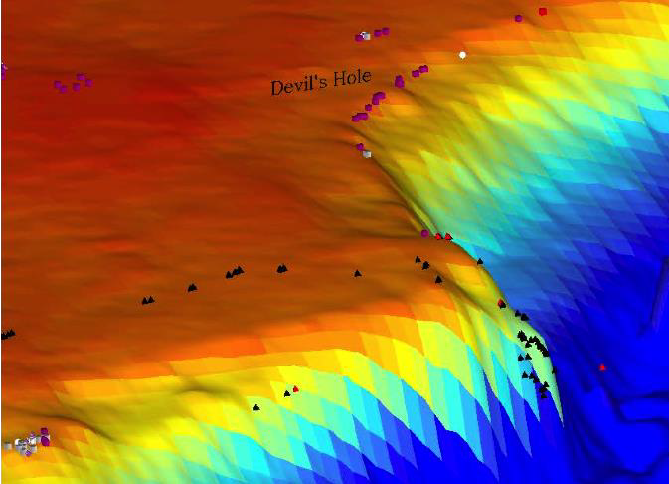
Photo: Bottom contour of the Devil’s Hole (also known as Georgetown Hole) off the coast of South Carolina. Credit: TNC
Lines of Communication: Conversations with the Council
Council initiative kicks off with November meetings in Georgia
Fishermen and others along the Georgia coast interested in federal fisheries are reminded that Lines of Communications: Conversations with the Council meetings will take place next week from Brunswick to Richmond Hill. The new initiative, known as “Lines” for short, involves in-person meetings in fishing communities where attendees can discuss their concerns and perspectives directly with Council members in an informal setting.
Unlike public hearings, Lines of Communication meetings are hosted by local Council representatives with the goal of having an open, two-way dialogue and mutual learning from constituents in the area. Lines meetings will be held in person throughout the South Atlantic, beginning with the series of meetings in early November in Georgia. The meetings will be facilitated, and both Council members and staff will be available throughout the evening to talk with local fishermen. Registration is not required, but an RSVP for the Georgia meetings will be helpful.

Upcoming Lines of Communication Meetings
Note: Meetings will be held from 6:00 – 8:00 p.m.
Tuesday, November 4, 2025
Georgia Sea Grant Marine Extension
715 Bay Street
Brunswick, GA 31520
Wednesday, November 5, 2025
Darien Lions Club
905 East Broad Street
Darien, GA 31305
Thursday, November 6, 2025
Richmond Hill City Center
JF Gregory Park
520 Cedar Street
Richmond Hill, GA 31324
Lines of Communication is an ongoing initiative, with two series of meeting held in two states within the Council’s jurisdiction annually. Following the Georgia meetings, the next series of meetings is planned for North Carolina in early February 2026. Learn more about Lines of Communication: Conversations with the Council by visiting the Council’s website: https://safmc.net/lines-of-communication-meetings/
Council Seeks Public Input on Proposed Management Measures for Black Sea Bass and Snapper Grouper Management Complex
Public hearings scheduled in November for Black Sea Bass; public scoping open for management complex
The Council is currently soliciting public input on management measures proposed for Black Sea Bass and the composition of the Snapper Grouper Fishery Management Unit (FMU). Public hearings are scheduled via webinar for measures proposed in Regulatory Amendment 37 addressing Black Sea Bass management. The Council is also requesting public input via online scoping on whether 17 species currently in the FMU continue to need federal conservation and management.
What’s the difference between public scoping and public hearings?
During public scoping the public can provide comments, make suggestions, or raise concerns early in the process as management options are being developed. Public hearings are held after management options have been narrowed down and a draft amendment outlining management alternatives, along with analyses, is developed.

Black Sea Bass – Public Hearings via Webinar in November
The Council is developing Regulatory Amendment 37 to quickly address the continuing decline in the Black Sea Bass stock in the South Atlantic. The amendment aims to reduce harvest and regulatory discards and protect the spawning stock.
The regulatory amendment proposes changing the recreational minimum size limit, reducing the bag limit, and establishing a spawning season closure for both commercial and recreational sectors for a minimum of two months. The amendment would establish recreational and commercial annual catch targets (ACTs) equal to 50% of the average landings of Black Sea Bass from 2019-2024.
Additional information, including a video presentation and a public hearing document are now available from the Council’s website.
Two public hearings will be held via webinar, the first on Monday, November 3rd and the second on Wednesday, November 12th. Both hearings will begin at 6 p.m. Council staff will provide an overview of actions being considered in the amendment and answer any clarifying questions. Following the presentation and questions, the public will have the opportunity to provide comments on the amendment. Register now to attend a public hearing via webinar and receive email reminders as the date approaches. Online public comments may also be submitted via the website through November 14, 2025.
Public comment will also be accepted during the Council’s December 8-12, 2025 meeting in Kitty Hawk, NC. The Council will consider all public comments during its December meeting and is scheduled to approve Regulatory Amendment 37 for review by the National Marine Fisheries Service and implementation in 2026.
Species in the Snapper Grouper Fishery Management Unit – Public Scoping for Snapper Grouper Amendment 61
The Council is requesting public input on whether 17 species in the Snapper Grouper Fishery Management Unit (FMU) should remain under federal management, be removed from the management plan, or be designated “ecosystem component” species. The latter means a species would continue to be included in the management plan for data collection purposes, but any management measures affecting that species would no longer apply.
The FMU currently contains 55 species. Additional details, including an online public comment form are currently available from the Council’s website.
Online scoping comments will be accepted through November 14, 2025.
Additional Snippets:
Speaking of Protecting Spawning Areas – FWC Recently Released an Update on Western Dry Rocks
As of August 1, 2025, Year 5 of the seasonal closure at Western Dry Rocks, an area off the Florida Keys, has officially wrapped up! Each year from April 1 to July 31, this closure helps protect fish like mutton snapper and gray snapper during their peak spawning season.
The spawning season closure is part of a 7-year effort to support sustainable fish populations in the Florida Keys. This year, during the closure, Florida Fish and Wildlife Conservation Commission researchers conducted 618 dives to monitor how these protections are working. The collected data will shape future conservation efforts, but you also play a big role! Watch the video to learn more.
Two Iconic Coral Species are Now Functionally Extinct off Florida – We witnessed the reef’s bleaching and devastation
In early June 2023, the coral reefs in the lower Florida Keys and Dry Tortugas were stunning. We were in diving gear, checking on hundreds of corals we had transplanted as part of our experiments. The corals’ classic orange-brown colors showed they were thriving. Just three weeks later, we got a call – a marine heat wave was building, and water temperatures on the reef were dangerously high. Our transplanted corals were bleaching under the heat stress, turning bone white. Some were already dead.
See this recent article in the Conversation for a first-hand account of how a global mass bleaching event has impacted two of Florida’s most important and iconic reef-building coral species, making them functionally extinct.
Mark Your Calendar
Keep track of meetings scheduled by the Council from the Meetings page of the website and register for meeting webinars as information becomes available. Register early and receive email reminders as the meeting date(s) approach!